
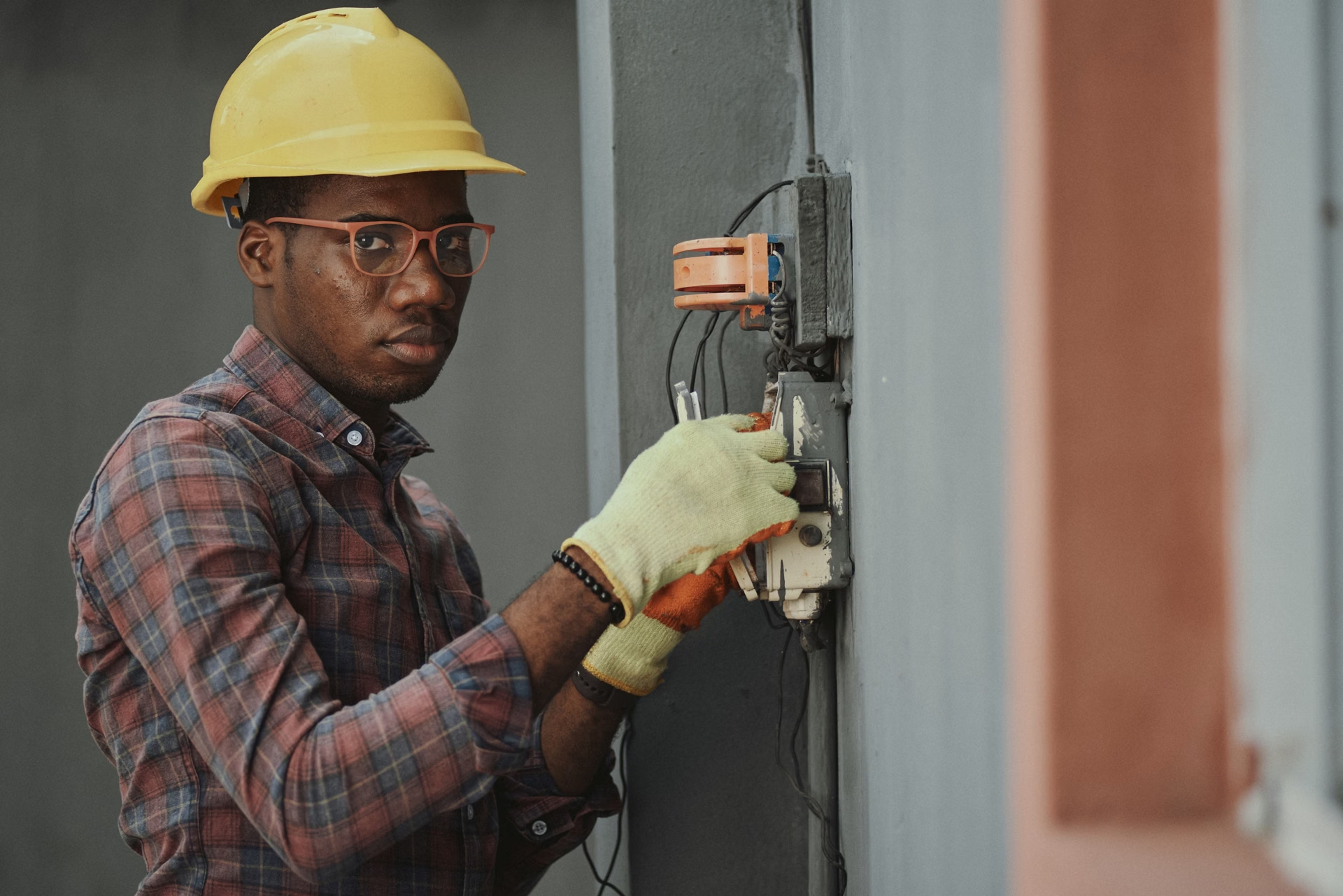
An ESA permit is the everyday name for a notification of work filed with the Electrical Safety Authority, the agency that oversees electrical safety in Ontario. ESA itself uses both terms: the Ontario Electrical Safety Code requires almost all electrical work to be reported by filing a notification of work, or permit. The filing creates a permanent record of what was done in the house and starts ESA's review of it.
This guide covers what a homeowner needs to know about the electrical permit Ontario requires for house wiring: which jobs need a notification, the narrow list of small jobs that do not, who is allowed to file, what ESA charges (as of October 2026), how inspection and the ESA Certificate of Acceptance work, how the electrical permit differs from a city or town building permit, how to check a contractor's licence, and what happens to an unfinished notification when a house is sold.
What Needs a Notification
The short answer is nearly everything. ESA's Homeowner Electrical Safety Handbook says almost all electrical work needs a notification of work filed with ESA. That covers new circuits, added receptacles and lights, pot lights, panel and service changes, EV chargers, generators connected to the house wiring, hot tub and pool equipment, and the wiring in a basement or kitchen renovation.
Some examples come straight from ESA's own pages. For a home EV charger, ESA says the Licensed Electrical Contractor doing the installation must file a notification of work before starting. For a standby generator, ESA says a notification is needed to connect it permanently to the home's wiring, and the unit needs a transfer device so it cannot feed power back into the utility system. For a service upgrade, relocation or replacement, ESA says the utility has to disconnect the power and the new installation must be inspected before power is restored.
So the honest answer to "do i need a permit to upgrade my electrical panel" is yes. A panel change or service upgrade is never one of the exempt jobs, and the utility will not reconnect an upgraded service without ESA's authorization.
The Small Jobs That Are Exempt: ESA Bulletin 2-3-19
ESA Bulletin 2-3-19 explains the limited cases where no notification is required. For the owner of an owner-occupied single dwelling, the exemption covers replacing a luminaire (light fixture) or a general-use switch, as long as the new device goes in the same location, is interchangeable with the one being replaced, and sits on a branch circuit of 15 amps or less at 130 volts or less. The bulletin also lets that owner replace a general-use switch with a dimmer, timer or motion sensor.
The exemption has firm edges. The bulletin says that for homeowners it does not include recessed lighting, aluminum wiring or ungrounded wiring such as knob and tube. Replacing a surface-mounted fixture with a recessed one is not a like-for-like change and needs a notification. Tenants who lease a home and owners of high-rise condominium units do not qualify for the homeowner exemption; they can still do permitted work only by filing.
Receptacles are treated differently. The bulletin's receptacle exemption applies to Licensed Electrical Contractors, not to homeowners, so an owner who swaps a receptacle should expect to file. If you are unsure whether a small job falls inside the exemption, treat it as needing a notification; the cost of filing is small next to the cost of an uninspected mistake.
Who Files: Contractor or Homeowner
The rule is that the person who does the work files the notification. When you hire a Licensed Electrical Contractor, the contractor files before starting and later gives you the ESA Certificate of Acceptance. ESA's EV charging page says a Licensed Electrical Contractor will always complete the filing for work it does.
Homeowners and occupants can do electrical work in their own home, but they must take out the notification themselves. ESA is equally clear about who cannot help: friends, family members and neighbours are not allowed to do electrical work in your home. If you pay anyone to do it, the law requires a Licensed Electrical Contracting Business. A Town of Ajax information flyer on ESA rules adds that general contractors and even qualified electricians may not do electrical work unless they are, or work for, a Licensed Electrical Contractor.
One practical warning follows from that rule. A contractor who asks you to file the permit in your own name is asking you to take responsibility for work you did not do. Since the homeowner filing route is meant only for owners doing their own work, that request is a reason to look elsewhere.
Can a Homeowner Replace an Electrical Panel in Ontario?
Legally, the homeowner DIY rule does not exclude panels: an owner may do electrical work in their own home after filing the notification. In practice, a panel replacement is one of the jobs where that route is hardest to follow, for three reasons.
First, it always needs a notification, because Bulletin 2-3-19's exemption is limited to certain fixtures and switches. Second, it involves the utility. ESA's homeowner handbook says that if a home needs a panel upgrade, the owner will need to contact the local utility, and Hydro One tells customers to apply for an ESA permit before making any change to the electrical service. Toronto Hydro, Elexicon Energy and Oshawa Power each want an ESA Connection Authorization or equivalent approval before restoring power. Third, ESA's fee guide charges a non-contractor more for the same service or panel change than it charges a licensed contractor, as the next section shows.
So the answer to whether a homeowner can replace electrical panel in Ontario is yes on paper, with a notification, an inspection and the utility's process. ESA also warns homeowners about anyone who claims the utility does not need to be involved in a panel change or service upgrade; that claim is wrong whoever makes it.
Have electrical work in mind? Get a free quote.
ESA Permit Fees as of October 2026
ESA publishes its charges in a wiring fee guide and a residential quick reference. As of October 2026, the 2026 Wiring Fee Guide sets a minimum fee of $92 for a notification for any wiring installation, and fees marked with an asterisk are raised to that minimum when the calculated total is lower.
For service work, the same guide lists a new service, service change, panel change or service repair at $86 for a licensed contractor, marked as subject to the minimum, and $212 when a non-contractor files. That gap is the clearest number in the schedule for a homeowner weighing a DIY panel change.
Renovations are filed on ESA's Residential Renovation form, and the fee depends on the scope of the work described on it. ESA notes that fees may change after a site visit if the work turns out to differ from what was filed. Because the schedule is revised from time to time, check the current fee guide on esasafe.com before you file, or ask your contractor whether the ESA permit fees are included in the quote, which is the normal practice when a contractor files.
Inspection and the ESA Certificate of Acceptance
After the notification is filed, the person who filed it arranges the inspection. ESA lets anyone who already has a notification submit an online request for inspection, and it also takes calls at 1-877-ESA-SAFE (372-7233). Work must not be concealed before ESA has reviewed it, so a renovation electrical permit usually means a rough-in inspection once the circuit wiring and boxes are in and before insulation, vapour barrier or drywall cover them, followed by a final review when the job is done.
For service work there is an extra link in the chain. When a new or upgraded service passes, ESA authorizes the utility to energize it, and that authorization is valid for up to six months from the date it is issued.
Once the work has been reviewed and passed, ESA issues the Certificate of Acceptance to the person who filed. ESA calls the certificate an important document for insurance purposes, resale and peace of mind. If a contractor filed, ask for a copy for your records, and keep it with the house documents.
ESA Permit or Municipal Building Permit?
These are two separate systems, and a project can need both. The ESA notification covers the electrical installation. A building permit from your city or town covers the building work under the Ontario Building Code: structure, additions, new suites and similar changes.
Ontario municipalities say this plainly. The City of Toronto's BuildSafeTO guidance says almost all electrical work in Ontario needs an electrical permit from ESA, obtained separately from a building permit. The Town of Ajax's flyer says having a building permit is not the same as filing an electrical notification, and that you may need both. The City of Vaughan lists electrical projects among work that generally needs no City permit, because ESA inspects them. The Municipality of Clarington's inspections page says electrical work must follow the Ontario Electrical Safety Code and an ESA permit must be obtained before work begins.
For a homeowner, the practical result is two sets of inspections that have to be sequenced. On a basement finish that needs a building permit, for example, the ESA rough-in review has to happen before the walls are closed, and the municipal inspections run on their own schedule, so the electrician and the general contractor need to plan those dates together.
Checking an Electrician's Licence
Because only a licensed business may be hired for electrical work, checking the licence is the first step in any hire. ESA's Contractor Locator Tool, at findacontractor.esasafe.com, needs no login. You can search by location, business name, licence number or phone number. A Valid status means the licence is active, Expired means it has lapsed, and a contractor who does not appear at all is not licensed.
KV Bear Electrical Inc. holds ECRA/ESA licence 7014730 and can be found in that tool. Whoever you hire, match the licence number on the quote to the name in the lookup, and confirm that the business, not the homeowner, will be filing the notification.
Open Notifications When Selling or Buying
A notification that was filed but never closed with a passed inspection does not disappear when the house changes hands. ESA explains that a buyer's lawyer can request a Search of Records as part of the purchase agreement. ESA's records date back to 2000, the search reports open electrical notifications on the property, and an open notification automatically transfers responsibility for fixing any electrical defects to the new owner.
For sellers, the useful step is to close loose ends before listing: find any past project where the final inspection never happened and get it reviewed. ESA suggests sellers can build a buyer's confidence by warranting in the Agreement of Purchase and Sale that required electrical permits were obtained and the work was inspected and passed. For buyers, ESA suggests asking the listing agent about recent electrical work, such as new pot lights or an EV charger, and cross-referencing it with ESA's records to see whether a permit was obtained.
Either way, the ESA Certificate of Acceptance for each project is the simplest proof. Keep every certificate together, and ask for a copy whenever a contractor finishes permitted work in the house.
Frequently Asked Questions
Is an ESA notification the same thing as an electrical permit?
Yes. ESA's term is a notification of work, and ESA itself says it is also called a permit. It is filed with the Electrical Safety Authority, not with your city or town, and it starts ESA's review of the work.
Can I change a light fixture myself without filing anything?
Often, yes. Under ESA Bulletin 2-3-19, the owner of an owner-occupied single dwelling can replace a luminaire or general-use switch in the same location with an interchangeable device on a circuit of 15 amps or less at 130 volts or less. The exemption does not cover recessed lighting, aluminum wiring or ungrounded wiring such as knob and tube.
Can my brother-in-law who is an electrician do the work if I file the permit?
No. ESA says friends, family members and neighbours cannot do electrical work in your home, and the homeowner filing route is only for owners doing their own work. Anyone else doing the job must be, or work for, a Licensed Electrical Contracting Business, which files its own notification.
What is the minimum ESA fee for a residential job in 2026?
As of October 2026, ESA's 2026 Wiring Fee Guide sets the minimum notification fee for any wiring installation at $92. Some items, such as a service or panel change filed by a licensed contractor, are listed below that and are raised to the minimum when the total is lower. Check the current guide before filing, since ESA revises its fees.
What happens to an open ESA notification when a house is sold?
According to ESA, an open notification automatically transfers responsibility for remedying electrical defects to the new owner. A buyer's lawyer can request ESA's Search of Records, which covers files back to 2000, so sellers are better off closing any open notification before listing.
Sources
- ESA: Electrical safety, a smart move for buyers and sellers
- ESA: Homeowner Electrical Safety Handbook
- ESA: Bulletin 2-3-19
- ESA: Do-it-yourself electrical work
- ESA: Electric vehicles and charging systems
- ESA: Generator safety
- ESA: What is a service connection inspection?
- ESA: The electrician you're looking for doesn't exist
- ESA: 2026 Wiring Fee Guide
- ESA: Residential Renovation notification form 1398B
- ESA: Notifications and inspections
- ESA: What is a rough-in inspection?
- ESA: Certificate of Acceptance
- ESA: Contractor Locator Tool FAQs and instructions
- ESA: Buying a renovated home
- Hydro One: Service upgrade
- City of Toronto: BuildSafeTO, learn about building permits
- Town of Ajax: Municipal ESA information flyer
- City of Vaughan: Building permits
- Municipality of Clarington: Inspections
Facts checked October 14, 2026.
KV Bear Electrical Inc. is a licensed residential electrical contractor (ECRA/ESA 7014730) based in Oshawa, Ontario. Facts in this guide are taken from the official sources listed above. Have a question about your home? Call 905-999-5048.
Related Services:
Related Guides
Hot Tub Electrical Requirements in Ontario: GFCI, Disconnect, Bonding and Permits
What Ontario's electrical code and ESA expect before a hot tub or swim spa is switched on, from the GFCI and the outdoor disconnect to the copper bonding ring, buried cable and the paperwork.
Read the guideAluminum Wiring: Pigtailing vs Full Replacement — Which Is Right for Your Home?
If your Ontario home has aluminum wiring, you have two main options: pigtailing or full replacement. Here is an honest comparison so you can make an informed decision.
Read the guideKnob and Tube Wiring in Ontario: Code Status, Risks, Assessment and Replacement
A homeowner's guide to knob and tube wiring in Ontario: the years it was installed, why the 2021 Code did not force removal, the hazards ESA and Natural Resources Canada describe, and how an assessment and a phased rewire work.
Read the guide