
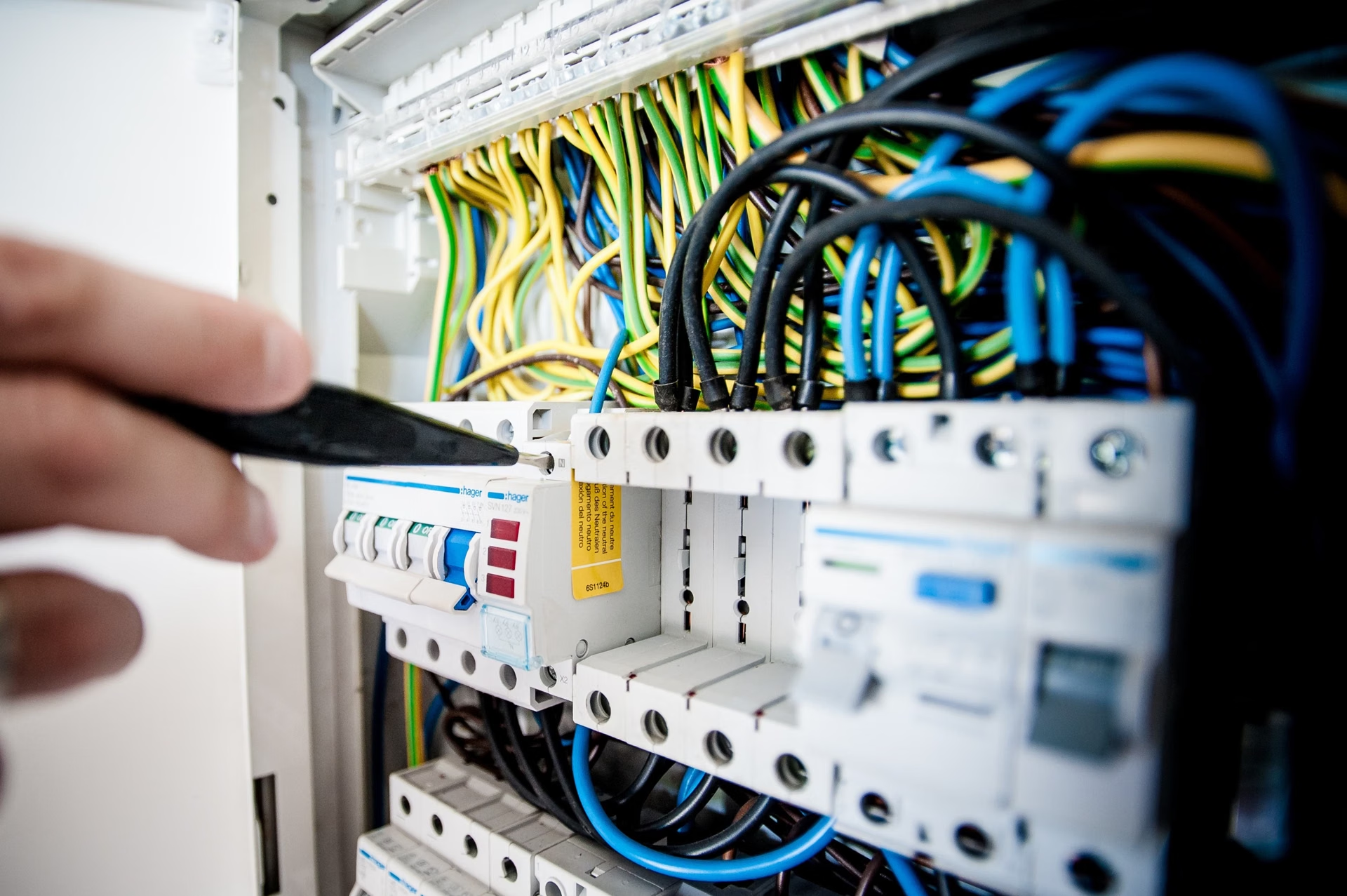
Open a switch box or look behind a receptacle and you may see a few different colours of insulation, and sometimes a copper wire with no insulation at all. Those colours are not decoration. In Ontario they follow rules in the Ontario Electrical Safety Code (OESC), which ESA describes as the Canadian Electrical Code, Part I, plus several Ontario-specific amendments. People often search for this as the electrical wire color code, with the American spelling, but the rules that apply here are the Canadian ones.
This post explains what each colour is meant to tell you in a house, the places where the code allows a colour to be changed with tape or paint, why the colour of the outer cable jacket is a different matter, and why no colour on its own proves a wire is safe to touch. It is a guide to reading what you see, not a set of instructions for doing the work.
Electrical Wire Colours at a Glance
In everyday terms, the colours in a home fall into three groups.
The neutral, which the code calls the identified conductor, is white. ESA's bulletin on conductor identification explains that Rule 4-024 1) requires all insulated neutral conductors up to and including No. 2 AWG, in any location, to be identified by a continuous white covering, or by three continuous white strips along the entire length of the conductor.
The bonding conductor, often called the ground, is green or bare. ESA's bulletin states that Rule 4-032 requires insulated bonding or grounding conductors up to and including No. 2 AWG to have a continuous outer finish that is either green or green with one or more yellow stripes. A bonding conductor can also be bare copper with no insulation: ESA's aluminum wiring flash notice refers directly to the bare bond conductor when it lists the terminations that need properly marked devices.
Everything else is an unidentified conductor, meaning a coloured wire that is not white or green. ESA's residential guidance describes cables with red and black conductors and cables with white and black conductors, and the next section explains when one of those colours is re-marked to take on a different role.
Why the Neutral Is White and the Bond Is Green
A neutral and a bonding conductor may sit side by side in the same box, but the code treats them as different conductors with different jobs, and the colours are how the next person to open that box tells them apart.
ESA gave a homeowner-relevant example when the 27th edition of the OESC took effect on May 16, 2019. That edition added a requirement to run an identified (neutral) conductor to each control (switch) location for a permanently installed luminaire.
Have electrical work in mind? Get a free quote.
When the Electrical Wire Colours Can Change
The code accepts a few situations where a conductor's colour does not match its job, provided it is re-marked. These are the cases that confuse homeowners most.
A red-and-black cable feeding 120 V equipment. ESA's specification for residential HVAC and hot water tank installations (ESA-SPEC-007) allows a cable with red and black conductors to supply 120 V equipment, as long as the coloured conductor is permanently changed at each accessible point in the circuit by white paint, sleeving, tape or equivalent means. The same document adds that the marking must not make the manufacturer's numbering on the conductor illegible.
A white-and-black cable feeding 240 V equipment. The same ESA document permits a cable with a white and black conductor for 240 V equipment, provided any exposed portion of the white conductor is permanently changed at each accessible point by coloured paint, sleeving, tape or equivalent means. In that case the white wire is not a neutral at all, and the coloured tape is the only clue.
A converted circuit. ESA's conductor identification bulletin gives the example of a natural gas water heater replacing an electric one. When a 240 V circuit is converted to 120 V, one of the unidentified conductors may be reused as the identified conductor, as long as its exposed portions are permanently marked with white paint, white sleeving, white tape or equivalent means at each accessible point.
Larger neutrals. For insulated neutrals larger than No. 2 AWG, ESA's bulletin explains that Rule 4-026 lets them be continuously identified or suitably labelled or marked at each end at the time of installation, using white paint, white sleeving, white tape or another equivalent method.
The practical lesson: a strip of tape around a wire can change what that wire is. If you see white tape on a red wire or red tape on a white one, treat the tape as the label, and have anything unclear checked by a Licensed Electrical Contractor.
Cable Jacket Colours Are a Different Thing
Sheathed cable, such as the NMD90 type named in the recalls below, has an outer jacket that comes in several colours. It is easy to assume the jacket colour is part of the code. ESA's bulletin on conductor and cable identification says it is not: some cable manufacturers colour code the jackets of cables meant for different purposes as a marketing tool. One scheme described there uses white for general purpose circuits, blue for AFCI circuits, yellow for 20 A kitchen circuits and red for 240 V circuits, but the bulletin presents it as a manufacturer practice rather than a requirement.
What counts is the conductor size printed on the cable. ESA states that inspectors will check the wire size, rather than the cable jacket colour, to make sure the correct wire has been used for the connected load.
Two Health Canada recalls show why. One covered a yellow 12/2 NMD90 cable sold on a spool that contained a 14-gauge neutral wire instead of the 12-gauge stated on the label. Another covered a red 12/2 pre-cut, coiled wire whose own cord markings showed 14 AWG; Health Canada said the shrink wrap should have read 14/2 and cited a fire hazard. In both cases the colour and the packaging pointed one way and the printed marking on the conductor told the real story.
Older Homes: When the Colour Code Does Not Apply
The colour rules above describe wiring installed to the current code. Older houses can look quite different.
Knob and tube wiring, which ESA dates to homes built from the early 1900s to the 1940s, has single insulated conductors carried on ceramic knobs and tubes. ESA's podcast episode on the subject describes two conductors with insulation made from a rubber-like material that can become brittle over time.
Aluminum branch circuit wiring is another case. ESA says a home built between the mid-1960s and late 1970s may have aluminum wiring, and some homes have a mix of aluminum and copper. ESA's aluminum wiring flash notice requires aluminum conductors, including the bare bond, to end on devices marked for them, so the metal matters as much as the colour of the insulation.
Because the code allows conductors to be re-marked and reused, as described above, the colours in an older box show what someone intended at the time, which is not always what the conductor does today.
Colour Never Proves a Wire Is Off
This is the most important point in the post. Colour tells you what a conductor was meant to be when it was installed. It does not tell you whether that conductor is live right now. The re-marking rules above already show that a white conductor can legally serve as one of the current-carrying conductors on a 240 V circuit.
ESA's flash notice on testing for voltage tells electrical workers to assume all equipment and systems are energized until they have been tested and verified. ESA also tells workers to check the tester on a known voltage source so they know it works. If trained workers are told not to trust appearances, homeowners should not trust a colour.
Under ESA's rules, you may do electrical work in your own home only after filing a notification with ESA, and friends, family members and neighbours cannot do it for you. Anyone you hire must be a Licensed Electrical Contractor. Our posts Canadian Electrical Code vs Ontario Electrical Safety Code: How They Fit Together and Common Electrical Code Violations in Ontario Homes go further into how the code is enforced and which problems inspectors flag.
KV Bear Electrical is a Licensed Electrical Contractor (ECRA/ESA 7014730). If you have found tape-marked conductors, an ungrounded circuit, mystery cables in the basement or wiring you cannot identify, call 905-999-5048 or request a quote for an inspection.
Frequently Asked Questions
What colour is the neutral wire in an Ontario house?
White. ESA's conductor identification bulletin explains that insulated neutrals up to No. 2 AWG must have a continuous white covering, or three continuous white strips. Larger neutrals can instead be marked with white paint, sleeving or tape at each end.
Is the ground wire green or bare copper?
It can be either. ESA's bulletin says insulated bonding conductors up to No. 2 AWG must be green or green with one or more yellow stripes, and ESA's aluminum wiring notice refers to the bare bond conductor.
Why does a white wire in my house have black or red tape on it?
ESA's residential guidance allows a white-and-black cable to feed 240 V equipment if the white conductor is permanently re-marked with coloured paint, sleeving or tape at each accessible point. The tape tells you that white wire is not being used as a neutral. Have a Licensed Electrical Contractor confirm what any unclear conductor is doing.
Does the colour of the cable jacket tell me the circuit size?
Not reliably. ESA says jacket colours are a manufacturer marketing practice rather than a code requirement, and inspectors check the wire size printed on the cable instead. Health Canada recalls of a yellow and a red 12/2 product that actually contained 14-gauge conductors show why the printed marking matters more than colour.
Can I tell a wire is dead by its colour?
No. ESA tells electrical workers to assume all equipment is energized until it has been tested and verified. Colour only tells you what a conductor was meant to be, not whether it is live right now.
Sources
- ESA: OESC Bulletin 4-5-15, Identification of conductors and cables
- ESA-SPEC-007 R10: Residential HVAC and Hot Water Tank Installations
- ESA Flash 22-03-FL: Test for voltage before you work
- ESA Flash 25-18-FL: Aluminum wiring
- ESA: Aluminum Wiring
- ESA: 27th Edition of the OESC Effective May 16, 2019
- ESA Podcast Episode 14: Knob and Tube Wiring
- ESA: Ontario Electrical Safety Code
- ESA: Do-It-Yourself (DIY) Electrical Work
- Health Canada: 12/2 NMD90 75M Romex SIMpull cable (yellow) recall
- Health Canada: Southwire 12/2 pre-cut red electrical wire recall
Facts checked October 22, 2026.
KV Bear Electrical Inc. is a licensed residential electrical contractor (ECRA/ESA 7014730) based in Oshawa, Ontario. Facts in this guide are taken from the official sources listed above. Have a question about your home? Call 905-999-5048.
Related Services:
Related Guides
Generator Transfer Switch: Ontario Rules, Types and Safe Hookups
A generator transfer switch keeps backup power inside your house and off the utility's lines. Here is what Ontario's rules require, how manual, automatic and interlock options differ, and what to ask before you buy.
Read the guideShould You Get an Electrical Inspection Before Selling Your Home?
If you are preparing to sell your Ontario home, getting a pre-sale electrical inspection can save you headaches, negotiation battles, and deal delays. Here is what it involves.
Read the guideAluminum Wiring in Ontario: Years, Warning Signs, Insurance and ESA Repair Rules
When aluminum branch wiring went into Ontario homes, why trouble shows up at the connections, what insurers ask for, the device and connector markings ESA Flash 25-18-FL requires, and the paperwork that settles insurance and resale questions.
Read the guide