
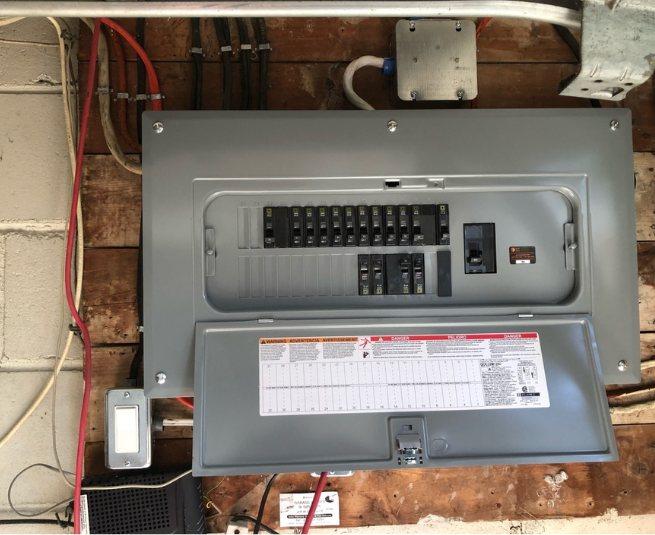
Every electrical panel has an amp rating. It is the most current the house can pull through the main breaker before that breaker trips. For a long time 100 amps was a normal size for an Ontario house, and it was enough when the big loads were a furnace fan, a stove and a dryer. A heat pump, an EV charger or a hot tub changes the math.
This post covers how the 100 amp vs 200 amp panel question really gets answered: what the rating means, which loads push a home past 100 amps, how a load calculation under Ontario's code settles it, and what an upgrade involves.
What the amp rating on your panel means
Start with the main breaker, the largest breaker in the panel. Toronto Hydro's heat pump guide says the amperage rating is printed on or near the main breaker, and that most homes have between 100 and 200 amps.
A 100 amp panel is built and protected for 100 amps in total, shared by every circuit in the house. A 200 amp electrical panel, which many people call a 200 amp breaker panel, has a 200 amp main breaker and space for more circuits. Elexicon Energy's comparison of the two sizes says a 200 amp panel is larger and has more circuits, so it can handle more power than a 100 amp one. It also notes that the 200 amp panel is more expensive.
The number really belongs to the whole service, not only the box on the basement wall. Power travels from the utility's transformer through the service wire to the meter base, then on to the main breaker. When a customer asks Elexicon to change the service size, say from 100A to 200A, a technician reviews the current service wire and determines whether there is sufficient capacity from the transformer to the meter base to support the upgrade. So a new 200 amp panel on a service that was never upgraded does not add capacity by itself.
When a 100 amp panel is still enough
Plenty of houses run well on 100 amps. Elexicon's guide says a 100 amp panel could serve you well in a mature home with gas heating or a gas stove, or where most of the appliances are older. The panel itself also needs to be in sound condition.
A heat pump does not automatically rule out 100 amps either. Natural Resources Canada (NRCan) says that, generally speaking, it is not necessary to upgrade the electrical service for an add-on air-source heat pump, the kind installed alongside a furnace. It adds that the age of the service and the total electrical load of the house may still make an upgrade necessary. One of NRCan's best-practices videos says there is typically room on a 100 amp service for a moderately sized heat pump system, even allowing for the safety factors the Canadian Electrical Code requires. In the house it follows, a two and a half tonne heat pump with a maximum rated capacity of 34 amps required a 40 amp breaker, and the presenters felt that was possibly doable on the owner's 100 amp service. That is one house, not a rule, which is why the calculation below matters.
Loads that push a home past 100 amps
Elexicon's guide says you will need a 200 amp electrical panel if you plan to install air conditioning, a pool, a hot tub or an EV charger. It also favours 200 amps for homes with electric baseboard heating, electric water heaters and other appliances that draw a lot of power.
EV charger. Alectra Utilities says a Level 2 charger can add significant electrical load to a home, generally 40 amps. Its EV calculator lists a 7.7 kW charger as needing a 40 A panel breaker, with a maximum output of 32 A. Hydro One notes that many older homes have a 100 amp main panel that may need to become a 200 amp service so a charger works well and the panel is not overloaded.
Heat pump as the main heat. NRCan says a 200 ampere service is normally required for an all-electric air-source heat pump or a ground-source heat pump, and that switching from natural gas or oil heat may mean a panel upgrade. Backup heat is a big part of it. NRCan's best-practices video points out that some contractors install electric resistance heaters sized for the full heating load of the home, which adds significant load to the panel. Toronto Hydro says panel updates for heat pumps come up most often in homes that are larger or not well insulated.
Electric range. In the code's load calculation, ESA's Bulletin 8-3 counts an electric range rated up to 12 kW at 6,000 W.
Hot tub, pool or central air. All three are on Elexicon's list of loads that call for 200 amps.
Have electrical work in mind? Get a free quote.
Licensed & Insured | ECRA/ESA 7014730
How a load calculation under the Ontario code decides it
Rules of thumb only go so far. The real answer comes from Section 8 of the Ontario Electrical Safety Code. Asked on ESA's podcast whether an EV charger means a service upgrade, ESA's guest said it depends on a load calculation from Section 8, or on historical demand for the dwelling.
For a single house, the calculation under Rule 8-200 starts with living area. ESA's Bulletin 8-3 lists a basic load of 5,000 W for the first 90 square metres and a basic load of 1,000 W for additional area. The range comes next at the 6,000 W noted above. The bulletin's table then adds the house's other loads, row by row, and ends with a calculated minimum ampacity for the service at 240 volts, single phase.
ESA's worked example shows how an ordinary house can pass 100 amps. It takes a single dwelling with a total living area of 140 square metres, about 1,500 sq. ft. With the loads in that example, the calculated minimum ampacity of the service comes to 108.6 A, more than a 100 amp service provides. Change the appliances and the result moves, which is why two houses of the same size can need different services.
The method has also changed recently. The 2024 Ontario Electrical Safety Code came into effect on May 1, 2025, and ESA lists a revised demand load calculation for single dwellings with EV charging loads among its updates. A calculation done years ago under an older edition may not match one done today.
EV load management instead of a 200 amp panel upgrade
When the only new load is an EV charger, a bigger service is not the only route. The code allows an electric vehicle energy management system (EVEMS) to control the charger. ESA's Bulletin 86-1-6 says that when an EVEMS controls the charging equipment, the charger's demand load is limited to the maximum the EVEMS allows. The bulletin also reasons that a charger with an adjustable output can be counted at the current it is set to. Either way, the calculation may stay within an existing 100 amp service. The catch is that the charger can only draw what the EVEMS allows at any moment.
Age matters too. In the same ESA podcast episode, the guest says the older a service is, the more likely it is to give trouble in the future, so the condition of an old panel belongs in the decision alongside the numbers. Our article EV Load Management in Ontario: When an EVEMS Can Spare You a Service Upgrade walks through that option in more depth.
What a 200 amp panel upgrade involves in Ontario
If the calculation says the service has to grow, the job has more steps than a panel swap.
1. Assessment. A Licensed Electrical Contractor looks at the panel, the service equipment and the wiring, runs the load calculation and sizes the new service.
2. ESA notification. ESA lets homeowners do electrical work in their own home only after filing a notification (permit) with ESA before starting. Friends, family members and neighbours cannot do it for them, and anyone hired must by law be a Licensed Electrical Contractor, who files the notification for the job.
3. The utility request. ESA's homeowner handbook says a home that needs a panel upgrade will need to contact its local utility, and that a Licensed Electrical Contractor can help. Each distributor has its own process. Hydro One asks for a service upgrade request when the amperage of a service goes up, and tells customers to contact ESA for a permit before work begins. Elexicon Energy treats a service size change as an upgrade, requested through its Connection and Upgrades Request form. If its review finds the existing service wire or transformer capacity is not sufficient, Elexicon will advise that an Offer to Connect is required.
4. Disconnect, install and inspect. ESA explains that for a service upgrade, relocation or replacement, the utility disconnects the power and the work must be inspected before power is restored. The service inspection may cover the meter base, the panelboard and the ground electrode, and nothing can be buried or covered before it happens.
5. Reconnection. When the work passes, ESA issues a connection authorization to the utility, valid for up to six months from the date it is issued. Elexicon states it cannot reconnect a service without a valid one.
6. The ESA Certificate of Acceptance. ESA says the certificate proves the work meets the Ontario Electrical Safety Code and calls it an important document for insurance, resale and peace of mind. Ask your contractor for a copy. If you cannot get one, ESA has an Access to Information form for requesting it.
What a 100 to 200 amp upgrade costs
As of October 2026, KV Bear Electrical publishes a range of $2,500 to $5,000 for taking a home from 100 to 200 amps. The final figure depends on the complexity of the job, whether the service entrance has to be upgraded as well, and the condition of the existing wiring. Where Elexicon requires an Offer to Connect, it says the offer comes with an engineered design and outlines the customer work and costs required. For the full breakdown, see What Does It Cost to Upgrade an Electrical Panel in Ontario?
Not sure whether your house needs 100 amps, load management or a 200 amp panel upgrade? Call KV Bear Electrical at 905-999-5048 or request a quote, and the load calculation will tell you which one fits.
Frequently Asked Questions
Can a 100 amp panel handle a Level 2 EV charger?
Sometimes. Alectra's EV FAQ says that anyone with a 100 amp panel who plans to add a charger should first assess the home's electrical capacity, since the panel or service may need upgrading if it cannot support the extra load. A load calculation answers it, and in some homes an EV energy management system keeps the charger within the existing service.
Is 100 amp service enough to run a heat pump?
For an add-on air-source heat pump working with a furnace, it often is. NRCan says a service upgrade is generally not necessary for that type, unless the age of the service or the house's total electrical load makes one necessary. For an all-electric air-source or ground-source system, NRCan says a 200 ampere service is normally required.
Will a new 200 amp panel give my house 200 amps on its own?
Only if the service feeding it is sized for 200 amps too. When Elexicon gets a request to go from 100A to 200A, a technician reviews the current service wire and whether there is sufficient capacity from the transformer to the meter base. If there is not, Elexicon will advise that an Offer to Connect is required.
How can I tell whether my house has a 100 amp panel?
Check the main breaker. Toronto Hydro's heat pump guide says the amperage rating should be printed on or near the main circuit breaker, and that most homes have 100 to 200 amps. The label tells you what the panel is rated for. Your contractor will also confirm what the service feeding it can carry.
Who files the ESA notification for a service upgrade?
The person doing the work. If you hire a Licensed Electrical Contractor, the contractor files it before the work starts. A homeowner doing their own work must file personally, and ESA says never to take out a notification on someone else's behalf. Once the work passes, ESA issues the Certificate of Acceptance to whoever filed.
Sources
- Elexicon Energy: 100 amp vs 200 amp
- Elexicon Energy: Residential upgrades, relocations and renovations
- Toronto Hydro: Electric heat pumps guide
- Natural Resources Canada: Heating and cooling with a heat pump
- Natural Resources Canada: Best practices in heat pumps (video)
- Alectra Utilities: Make a service request
- Alectra Utilities: EV calculator
- Alectra Utilities: EV FAQs
- Hydro One: Electric vehicles
- Hydro One: Service upgrades
- ESA OESC Bulletin 8-3-15: Service calculations for single dwellings
- ESA podcast, Episode 15: EV Supply Equipment (transcript)
- ESA: 2024 Ontario Electrical Safety Code is now available
- ESA OESC Bulletin 86-1-6: Electric vehicle supply equipment
- ESA: Do-it-yourself (DIY) electrical work
- ESA Homeowner Electrical Safety Handbook: Inside Your Home
- ESA: Notifications and inspections
- ESA: What is a service/connection inspection?
- ESA: Obtain a Certificate of Acceptance
Facts checked October 23, 2026.
Licensed electrician (ECRA/ESA 7014730) working in 31+ Ontario communities, including Cobourg, Oshawa, Whitby, Peterborough, and Toronto. Got a question? Call 905-999-5048 for a free quote.
Related Services:
Related Guides
Pigtailing Aluminum Wiring vs Full Replacement: Safety, Connectors and Cost
Pigtailing and full copper replacement both deal with aluminum wiring, but they are different jobs. How does a pigtail work, what do ESA and the U.S. CPSC say about connectors, and which of the two suits your house?
Read the guideElectrical Fire Smell: What It Smells Like, the Warning Signs and What to Do
ESA describes an electrical fire smell as the smell of hot plastic insulation. This guide covers where that smell comes from, the other warning signs of an electrical fire hazard, the habits that make cords and outlets overheat, what to do in an electrical fire and when to call a Licensed Electrical Contractor.
Read the guideHot Tub Electrical Requirements in Ontario: GFCI, Disconnect, Bonding and Permits
Ontario's electrical code and ESA set out what has to be done before a hot tub or swim spa is switched on: the GFCI and the outdoor disconnect, the copper bonding ring, buried cable and the paperwork.
Read the guide